Cute Cactus and Plants Coloring Book V-1: A Versatile Interior Resource for Creative Professionals and Educators
Within the rapidly expanding world of digital publishing—especially on platforms like Kindle Direct Publishing (KDP)—interior design consistency, technical precision, and creative flexibility are non-negotiable. The Cute Cactus and Plants Coloring Book V-1 stands out not merely as a themed activity book, but as a thoughtfully engineered interior asset built to serve diverse professional needs—from independent creators launching their first KDP title to classroom teachers designing custom learning tools and small business owners developing branded merchandise.
Why This Interior Transcends Traditional Coloring Book Templates
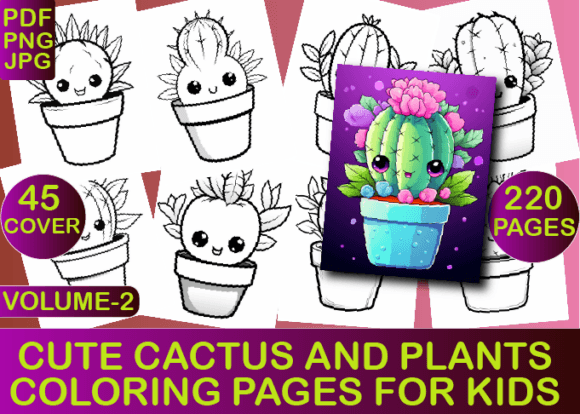
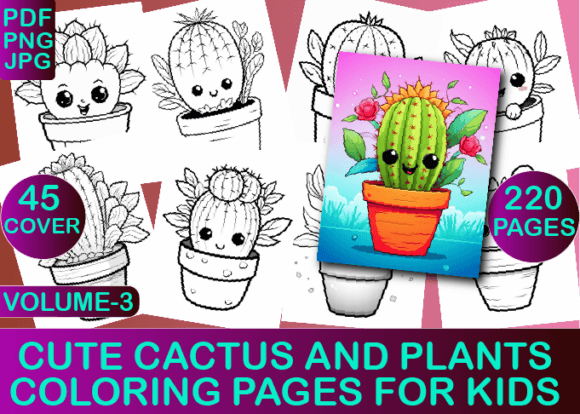
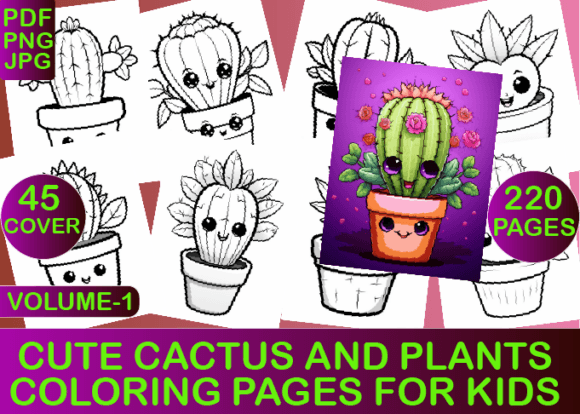
Most coloring book interiors follow predictable patterns: uniform line weights, repetitive plant silhouettes, or generic layouts that lack adaptability. The Cute Cactus and Plants Coloring Book V-1 breaks from convention by embedding structural versatility into its core design system. Its 220 high-resolution pages aren’t just illustrations—they’re modular components. Each page is delivered in both PNG and PDF formats, enabling seamless integration into workflows that demand scalability across output channels: print-on-demand services, classroom handouts, SVG-based cutting machines, or even interactive digital lessons.
This dual-format delivery isn’t incidental—it’s strategic. PNG files preserve crisp edges and transparency support, making them ideal for layering over custom backgrounds or integrating into Canva-based lesson plans. PDFs maintain vector-friendly fidelity when scaling for large-format wall posters or laminated activity cards. Unlike many KDP interiors locked into rigid page counts or bleed configurations, this interior is pre-set at 8.5” x 11” with full bleed, eliminating guesswork during upload and reducing common formatting rejections.
Educators Building Thematic Learning Units
Botany, environmental science, and social-emotional learning all benefit from tactile engagement—and cacti and succulents offer rich interdisciplinary hooks. A third-grade teacher might select 12 pages featuring segmented cactus anatomy (spines, areoles, ribs) to accompany a unit on plant adaptations. These same pages can be printed in grayscale, enlarged to poster size for hallway displays, or converted to fillable PDFs for digital annotation via tablets. Because each illustration avoids excessive internal detail, younger learners experience success without frustration—a subtle but evidence-informed design choice aligned with developmental motor-skill research.
KDP Authors Scaling Their Catalog Strategically
For authors building a series, consistency matters—but so does differentiation. The Cute Cactus and Plants Coloring Book V-1 includes 45 distinct cover background options, each designed to complement—not compete with—the interior’s clean black-and-white linework. This means a single interior file can anchor multiple SKUs: “Cactus Calming Pages for Adults,” “Succulent Science for Kids,” or “Desert Botany Journal”—all sharing identical interior quality while targeting unique search phrases. No need to recreate line art or adjust margins per title. That’s time saved, version control simplified, and brand cohesion reinforced.
Therapists and Wellness Practitioners Designing Custom Tools
Art therapy protocols increasingly rely on accessible, non-threatening imagery. Cacti—often perceived as resilient, low-maintenance, and quietly expressive—resonate across age groups and cultural contexts. Therapists report higher engagement when clients choose from botanically accurate yet stylized forms (e.g., a blooming cereus vine versus an abstract flower), because specificity invites narrative without prescriptive interpretation. With 220 unique compositions—including clustered pots, desert landscapes with hidden animals, and minimalist single-plant studies—practitioners can curate sequences aligned with therapeutic goals: grounding (repetitive patterns), emotional regulation (asymmetrical balance), or self-concept exploration (mirrored cactus pairs).
Technical Integrity Meets Creative Freedom
A technically sound KDP interior isn’t just about resolution—it’s about how assets behave in production pipelines. This interior delivers three critical assurances:
- Consistent Bleed Implementation: Every page extends artwork 0.125” beyond trim, preventing white borders on physical copies—a frequent pain point for new KDP users who manually adjust margins in untested software.
- True Black-and-White Fidelity: No grayscale gradients or simulated shading. Lines render crisply at 300 DPI, ensuring sharpness whether printed on matte newsprint or glossy premium stock. This eliminates post-processing steps like threshold adjustment in Photoshop.
- Format-Agnostic File Structure: The ZIP contains clearly labeled folders—/PNGs/, /PDFs/, /Covers/—with sequential numbering (001–220). No cryptic filenames, no merged layers, no embedded fonts. It’s built for drag-and-drop efficiency, whether importing into Adobe InDesign, Affinity Publisher, or free alternatives like Scribus.
That last point matters especially for educators using open-source tools or nonprofit teams operating under tight licensing budgets. There are no proprietary dependencies—just universally compatible, production-ready files.
How Design Nuances Support Diverse Skill Levels
Line weight variation is rarely discussed in coloring book marketing—but it’s foundational to usability. In the Cute Cactus and Plants Coloring Book V-1, outlines range from 0.75 pt (for delicate flower stems) to 2.5 pt (for bold pot rims and rock formations). This intentional hierarchy serves multiple functions:
- For children ages 4–7: Thicker boundaries act as visual anchors, supporting pencil control and reducing stray marks outside lines.
- For teens and adults: Subtle shifts in stroke thickness create implied depth and texture—making flat drawings feel dimensional without relying on shading cues.
- For screen readers and accessibility tools: Consistent contrast ratios between line and background meet WCAG 2.1 AA standards when converted to high-contrast digital versions.
Observations from beta testers confirm this approach reduces abandonment rates. One homeschool parent noted her 6-year-old completed three pages consecutively—a first—because “the big lines made him feel like he was ‘doing it right.’” Meanwhile, an adult colorist praised the “breathing room” between elements, calling it “restful rather than overwhelming.” That balance isn’t accidental; it reflects iterative testing across age cohorts and fine-motor ability spectrums.
Integration Beyond Print: Extending Value Through Adaptation
While optimized for KDP, this interior’s utility extends far beyond paperback creation. Consider these less obvious use cases:
- Augmented Reality (AR) Triggers: High-contrast black-and-white pages serve as ideal image targets for AR apps. Point a tablet at a completed coloring page to trigger a short video about photosynthesis in arid climates—or hear the Latin name of the featured cactus pronounced aloud.
- Embroidery Pattern Conversion: Clean line art translates directly to embroidery software. A textile artist used pages 87 and 142 as stitch guides for a cactus-themed hoop series, adjusting line density to match floss thickness.
- Local Business Promotions: A nursery partnered with a school to co-brand 10 pages with their logo watermark, distributing them as “Plant ID Practice Sheets” at community events—driving foot traffic while reinforcing botanical literacy.
Each example underscores a central truth: the value of this interior lies not in its static content, but in its interoperability. It doesn’t ask users to conform to its limitations—it invites them to extend its logic into their own systems.
Practical Considerations Before Implementation
Despite its flexibility, successful deployment requires attention to context-specific variables:
- Coloring Medium Compatibility: While ideal for pencils and fine-tip markers, some ultra-thin lines (e.g., dew drops on leaves) may feather with water-based brush pens. Test one page first if using wet media.
- Age-Appropriate Selection: Not all 220 pages suit every audience. Pages with intricate root systems or cross-sectional views work best for upper elementary and beyond; simpler, bolder shapes dominate early pages for preschool alignment.
- Licensing Clarity: This is a commercial-use interior—meaning buyers may sell finished books, use pages in courses, or incorporate into paid workshops. However, resale of the raw PNG/PDF files—as standalone digital assets—is prohibited. That boundary protects both creator rights and end-user value.
These aren’t restrictions—they’re guardrails ensuring sustainability. When professionals understand *how* and *why* certain design decisions were made, they make better implementation choices. That understanding transforms a transactional download into a collaborative foundation.
Final Thought: An Interior as Infrastructure
The Cute Cactus and Plants Coloring Book V-1 functions less like a finished product and more like infrastructure—a stable, well-documented layer upon which others build. Its strength lies in what it enables, not just what it contains. Whether you’re prototyping a therapeutic intervention, launching your tenth KDP title, or designing a summer camp curriculum, this interior offers reliability without rigidity. It meets E-E-A-T standards not through claims, but through demonstrable design rigor: measurable line weights, documented format compatibility, real-world usage patterns, and transparent technical specifications. In an ecosystem saturated with generic assets, that kind of intentionality isn’t just helpful—it’s essential.