Cute Sea Animal Coloring Pages for Kids
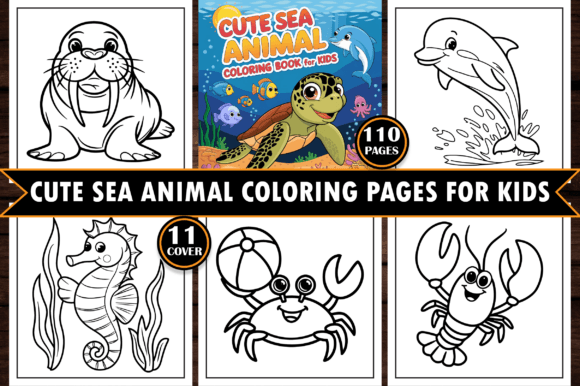
Coloring isn’t just a pastime—it’s a quiet catalyst for focus, emotional regulation, and early learning. Today’s caregivers, educators, and creative entrepreneurs are increasingly turning to purposefully designed coloring resources—not as filler activities, but as intentional tools that align with developmental needs, classroom goals, and even small-business workflows. At the heart of this shift are resources like Cute Sea Animal Coloring Pages for Kids, especially those bundled in cohesive, production-ready collections such as the I Love Ocean Animals Coloring Book for Kids. With 110 bold, easy-to-color marine life illustrations—from smiling octopuses and wide-eyed seahorses to gentle manatees and curious narwhals—this collection reflects a broader movement toward educational play that feels joyful, not instructional.
Why Ocean-Themed Coloring Resonates Now
Ocean themes have moved beyond summer crafts or beach vacations. They’re appearing in preschool curricula, SEL (social-emotional learning) toolkits, therapy sessions, and even mindfulness resources for children. Why? Because marine life offers rich visual variety without overwhelming complexity: soft curves of jellyfish tentacles, repeating patterns on coral, expressive eyes on dolphins, and strong silhouettes of whales—all naturally suited to early motor skill development. Unlike abstract or highly detailed fantasy scenes, sea animals provide recognizable forms with gentle contours, making them ideal for ages 3–9. That balance—between engagement and accessibility—is what makes Cute Sea Animal Coloring Pages for Kids both pedagogically sound and commercially viable.
This timing also aligns with growing public awareness of ocean conservation. Children today hear terms like “plastic pollution,” “coral bleaching,” and “marine protected areas” earlier than previous generations. A coloring page of a sea turtle swimming past a clean reef isn’t just art—it’s a subtle entry point into empathy for real ecosystems. Educators report that pairing these pages with short, age-appropriate facts (“Did you know sea turtles can swim 20 miles per hour?”) builds vocabulary, listening stamina, and environmental literacy—without requiring formal lesson planning.
Designed for Real-World Use—Not Just Aesthetic Appeal
The I Love Ocean Animals Coloring Book for Kids stands out because it was built with workflow in mind—not just child appeal. Its 8.5×8.5″ square format fits standard paper sizes and print-on-demand platforms like KDP and Etsy without cropping or scaling adjustments. Each of the 110 designs is intentionally bold-lined, with generous white space and clear negative areas—critical for young hands still developing pencil control. There’s no fine cross-hatching or tightly packed background elements that frustrate beginners.
For creators and small business owners, the package goes further: it includes 110 high-resolution PNG and JPG files (300 dpi), a print-ready PDF, an editable EPS vector file, and 11 cover background options. This isn’t just a coloring book—it’s a production kit. A freelance illustrator can drop individual PNGs into Canva templates for social media posts. A homeschool parent can print single pages for travel or rainy-day kits. An Etsy seller can bundle the files with themed stickers or ocean-themed activity cards. The flexibility reduces friction between idea and execution—a key advantage in markets where speed, consistency, and scalability matter.
More Than Entertainment: Cognitive and Creative Benefits
Research consistently links structured coloring to improvements in attention span, hand-eye coordination, and symbolic thinking. But what’s often overlooked is how theme choice influences engagement. Children who connect emotionally with a subject—like caring for animals or imagining underwater adventures—spend more time with the material and return to it voluntarily. A dolphin isn’t just a shape to fill; it’s a character with personality, movement, and habitat. That narrative layer invites storytelling, sequencing (“What happens next?”), and even early science reasoning (“Why does this fish have stripes?”).
Teachers using these pages in mixed-age classrooms note another practical benefit: differentiation. One child might color quietly while another labels parts of a whale (blowhole, fluke, baleen). A third might cut out their finished octopus and use it in a diorama. The same page supports multiple learning objectives—art, biology, language, and fine motor—without needing separate materials.
Supporting Adult Roles—Without Adding Burden
Parents, teachers, and content creators aren’t looking for more work—they’re looking for reliable, low-lift solutions that serve layered goals. That’s where thoughtful design shines. These Cute Sea Animal Coloring Pages for Kids require no prep: no laminating, no cutting, no sourcing additional supplies. They’re ready to print, download, or embed directly into digital learning platforms. For remote learning facilitators, the PNG files integrate cleanly into Seesaw or Google Slides with annotation tools. For therapists, the consistent line weight supports sensory regulation exercises—coloring within boundaries becomes a grounding activity.
Even marketing professionals find utility here. Bloggers covering early childhood education or eco-conscious parenting can feature individual pages as free downloadable lead magnets—building email lists while offering genuine value. The ocean theme lends itself naturally to seasonal campaigns (World Oceans Day in June, Earth Day in April) and evergreen content (back-to-school relaxation, summer learning loss prevention).
Looking Ahead: Simplicity with Depth
The future of children’s creative resources isn’t about adding more features—it’s about deepening intentionality within simplicity. We’re seeing fewer “busy” pages cluttered with borders and more emphasis on breathing room, expressive subjects, and thematic coherence. The I Love Ocean Animals Coloring Book for Kids exemplifies this: its 110 designs avoid repetition through thoughtful variation—different perspectives (side view, top-down, close-up), habitats (kelp forest, open ocean, tide pool), and behaviors (leaping, resting, migrating). That nuance keeps children engaged across repeated use, supporting sustained interest rather than one-off novelty.
For creators entering the digital product space, this signals a clear opportunity: buyers increasingly favor bundles that solve multiple problems at once—teaching, printing, branding, and licensing—with minimal overhead. The inclusion of EPS and multiple raster formats means users aren’t locked into one platform or software. That interoperability isn’t a technical footnote—it’s a reflection of modern creative practice, where people move fluidly between Canva, Adobe Express, Procreate, and physical print.
Ultimately, Cute Sea Animal Coloring Pages for Kids succeed not because they’re “cute”—though they are—but because they meet real needs with quiet precision. They support calm in chaotic days, spark curiosity without pressure, and give adults trustworthy tools that don’t demand extra time or expertise. In a world full of digital distractions and overstuffed curricula, sometimes the most powerful learning happens slowly, softly, with crayon in hand—and a sea turtle waiting patiently on the page.