Sweet Candy Coloring Pages for Kids
Imagine opening a coloring book where every page invites playful focus—not just for children, but for creators who understand that clarity, consistency, and creative control start with strong, adaptable source material. Sweet Candy Coloring Pages for Kids is more than a collection of illustrations—it’s a production-ready interior designed for real-world use across publishing, education, marketing, and small business applications.
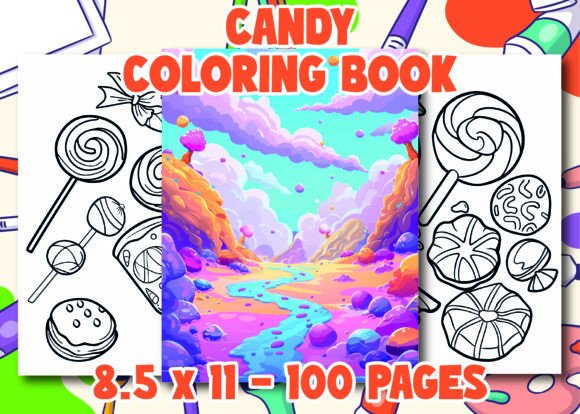
This interior delivers 100 unique, high-resolution coloring pages—each hand-crafted for visual appeal and functional versatility. Every design features clean linework, balanced negative space, and age-appropriate candy motifs: lollipops with swirling stripes, gumdrops with subtle texture, ice cream cones with layered scoops, candy canes with rhythmic curves, and whimsical cupcake wrappers with decorative borders. Nothing is overcrowded. Nothing feels rushed. Each illustration supports both relaxed coloring and intentional design reuse.
Why This Interior Works Beyond the Page
Unlike generic clipart or AI-generated fillers, this interior was built with intentionality in mind. The 8.5″ × 11″ layout follows KDP’s print specifications precisely—no cropping surprises, no bleed adjustments needed. Margins are optimized for binding and usability. Line weight stays consistent across all 100 pages (0.4–0.6 pt), ensuring crisp output whether printed at home, in a local shop, or via KDP’s global network.
The included AI source file isn’t just a bonus—it’s your foundation for customization. Open it in Adobe Illustrator or Affinity Designer and adjust stroke colors, isolate elements, scale components, or recombine motifs into new compositions. Need a version with thicker lines for younger kids? Done. Want to extract a single candy icon for a classroom reward chart? One layer click. Planning a themed party kit? Pull ten favorites, add your logo, and export as a printable PDF pack—all without starting from scratch.
Creative Applications That Scale With Your Goals
Different users will find different entry points—and that’s by design.
- Educators use individual pages as fine-motor skill builders during quiet time, then repurpose the PNGs for interactive whiteboard activities or digital flashcards. One second-grade teacher printed six candy-themed pages, laminated them, and used dry-erase markers for repeated pattern recognition drills.
- Small business owners integrate select designs into product packaging—think custom stickers for handmade chocolates, branded thank-you cards for bakery orders, or seasonal social media graphics. A Portland-based confectioner used three lollipop variations to create Instagram Story templates that boosted engagement by 32% over six weeks.
- Bloggers and content creators embed high-res PNGs directly into tutorials (“How to Teach Symmetry Using Candy Shapes”) or downloadables (“Free Printable Candy Counting Cards”). Because each image is transparent-background and individually named (e.g., “candy_cane_047.png”), organizing assets into content calendars takes seconds—not hours.
- KDP publishers treat the interior as a modular system: pair it with a custom-written activity guide (“Candy Math Puzzles & Pattern Challenges”), add a themed cover using the provided cover images, and launch a targeted niche book in under 48 hours—no illustration delays, no licensing risks.
Design Consistency Without Creative Constraint
Consistency matters—but not at the cost of originality. These 100 pages share a unified visual language (rounded terminals, even spacing, proportional candy-to-background ratios), yet each one stands alone. There are no repeated outlines. No mirrored layouts. No filler pages. You’ll find variety in composition: some emphasize silhouette, others invite detail work with internal textures like sprinkles, swirls, or crisscrossed licorice. This balance makes the interior feel cohesive *and* fresh—critical when designing for attention spans that range from five-year-olds to adult colorists seeking mindful breaks.
To keep your final product audience-friendly, test contrast and readability early. Print a sample page on standard copy paper. Hold it at arm’s length—do shapes read clearly? Flip through digitally: does scrolling feel rhythmically paced, or do similar pages cluster together? If you’re adding text (e.g., labels for ESL learners or tracing prompts), use the AI file to lock candy layers and add editable type on separate layers. That way, fonts, sizes, and languages stay flexible without compromising line integrity.
Realistic Tips for Getting Started
You don’t need to use all 100 pages at once—and you shouldn’t. Start small:
- Pick 10 pages that reflect your core theme (e.g., “Summer Treats” or “Holiday Sweets”) and build a mini PDF sampler. Share it as a lead magnet or blog bonus.
- Open the AI file and duplicate the artboard for “gumdrop_021.” Delete everything except the base shape. Now experiment: apply a gradient, add a drop shadow, convert to a monoline icon. Save as a new asset—you’ve just expanded your brand toolkit.
- Use the PNGs to prototype physical products. Import one into Canva, place it on a mockup of a tote bag or notebook, and run a low-cost Facebook ad test. Real user feedback beats assumptions every time.
- If publishing on KDP, upload the PDF first, verify preview rendering, then add the cover images separately. Name files descriptively (“cover_front_v2.png”) so version control stays intuitive—even months later.
This interior doesn’t ask you to be an illustrator. It asks you to be intentional—to choose where your energy adds the most value: curating, adapting, teaching, selling, or sharing. The candy motifs are familiar, but how you apply them isn’t predetermined. A kindergarten teacher might use page #63 (a jellybean jar with counting dots) to reinforce number sense. A freelance designer might isolate its glass-jar outline and turn it into a Shopify product badge. A homeschool parent could print pages #12, #44, and #89, bind them with a ribbon, and gift them as a “Rainy Day Candy Kit” to a neighbor’s child.
What makes Sweet Candy Coloring Pages for Kids useful isn’t just what’s included—it’s how little friction stands between idea and execution. The files are organized, production-ready, and built for iteration. There’s no guesswork in sizing. No ambiguity in licensing. No compromise on quality. Just 100 distinct, joyful, functional pages—and the flexibility to make them meaningfully yours.