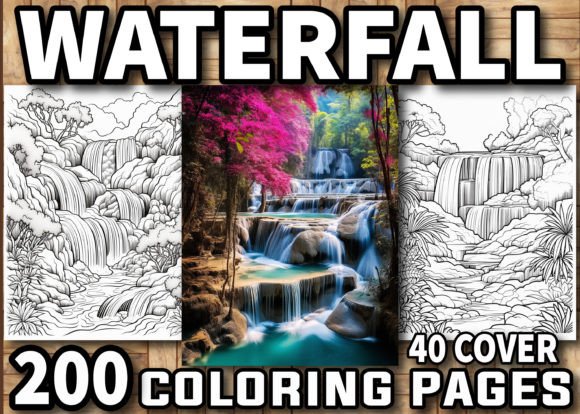
200 Waterfall Coloring Pages for Adults
Waterfalls hold a quiet power—fluid yet focused, dynamic yet calming. That duality makes them uniquely suited for adult coloring: intricate enough to engage the mind, serene enough to ease it. 200 Waterfall Coloring Pages for Adults delivers exactly that balance—not as generic nature scenes, but as thoughtfully composed, high-resolution line art designed for intentionality, not just decoration.
This isn’t a collection of repeated templates. Each of the 200 pages presents a distinct waterfall composition: cascading over mossy granite, tumbling through mist-laced forest gorges, spilling from cliffside caves, or winding down tiered limestone steps. Some emphasize architectural rhythm—sharp angles, repeating curves, layered horizontals—while others lean into organic flow: swirling mist, overlapping ferns, water-slicked rocks with subtle texture cues. All are drawn at 300 DPI in A4 and 8.5×11″ dimensions, optimized for clarity on paper and compatibility with KDP’s interior requirements.
Creative Direction Starts With Intention
Before picking up a pencil or opening a design tool, consider *why* this set works so well across disciplines. The waterfall motif is inherently versatile—it bridges realism and abstraction, structure and motion, detail and negative space. That flexibility means you’re not limited to “coloring books.” You’re working with a visual vocabulary.
For illustrators and surface pattern designers, these pages serve as foundational motifs. Isolate a single cascade silhouette and repeat it in a seamless tile. Trace the curve of a mid-air water arc and adapt it into a logo swoosh or brand icon. Use the layered rock strata as inspiration for a textile repeat pattern—then recolor it in your client’s brand palette. Because each page is delivered in JPG, PNG, and print-ready PDF, you can import cleanly into Procreate, Illustrator, or Canva without quality loss.
Practical Uses Beyond the Page
Here’s where practicality meets creativity:
- Educators and therapists use select pages as tactile mindfulness prompts—assigning one waterfall per week, asking students or clients to reflect on flow, resistance, or renewal while coloring. The consistent theme builds continuity; the variation prevents habituation.
- Bloggers and content creators repurpose individual pages as downloadable lead magnets—e.g., “5 Calming Waterfall Pages for Focus” — then link to the full set. Because all files are print-ready, there’s no need to reformat or compress before sharing.
- Small publishers and indie authors integrate selected illustrations into guided journals (“Reflect on Change While Coloring This Cascade”) or combine them with short nature essays—no licensing hurdles, since you own full commercial rights to use and resell.
- Freelance designers build custom stationery: turn a narrow vertical waterfall into a border for thank-you cards, or crop a wide-angle fall into a wraparound notebook cover. The included 40 high-res cover PNGs give immediate options—or serve as editable base layers.
What makes this especially valuable is consistency *without* repetition. You won’t find 200 versions of the same waterfall rotated slightly. Instead, you’ll notice thoughtful progression: early pages focus on clear line weight and open spaces (ideal for beginners or fine-tip pens), while later ones introduce tighter linework, overlapping elements, and controlled density—supporting skill development across the book.
How to Keep Your Output Clear and Audience-Friendly
Whether you’re publishing on KDP, selling digital downloads, or adapting for workshops, clarity starts with alignment—not just between image and purpose, but between your audience’s needs and how you present the work.
If you’re targeting stress relief seekers, prioritize pages with strong horizontal lines and generous white space. Pair them with minimal instructions—“Breathe in as you trace the top of the fall; breathe out as you follow the water down.” For art students or illustration clients, highlight pages with complex shadow logic or perspective cues—and include brief notes in your product description about line hierarchy or compositional anchors.
When preparing for KDP upload, use the provided PDF interior file as-is: it’s pre-formatted, bleed-free, and sized correctly. Don’t try to “enhance” resolution—the 300 DPI JPGs and PNGs are already optimized for sharp printing. If you’re adding text overlays (e.g., affirmations or journal prompts), place them in safe zones—minimum 0.25″ margin—to avoid trimming issues.
Realistic Adaptation Across Platforms
You don’t need to launch a full coloring book to get value from this set. Try these low-effort, high-impact adaptations:
- Instagram carousels: Post one waterfall per slide with a short caption about flow, patience, or release. Use the PNG files—they retain transparency if you want to overlay text cleanly.
- Email newsletter headers: Resize a single waterfall illustration to 600px wide, add subtle opacity, and layer your headline over it. Instant visual cohesion.
- Workshop handouts: Print 5–10 pages back-to-back on recycled paper, staple, and bind with twine. Add a half-page reflection prompt on the last sheet. Done.
- Brand mood boards: Drop three waterfall JPGs into Milanote or Miro alongside color swatches and typography samples. Their natural rhythm subtly reinforces themes of movement and harmony.
And because you receive all formats—JPG for quick web use, PNG for transparency needs, PDF for direct KDP upload—you’re never stuck waiting for conversions or wrestling with compatibility. It’s ready infrastructure for your ideas.
Originality Comes From Application, Not Just Imagery
Let’s be clear: no one buys a coloring page for its novelty alone. They buy it for what it *enables*. The originality in 200 Waterfall Coloring Pages for Adults lies in how deliberately each piece invites reinterpretation—not as static art, but as raw material.
One designer used the mist patterns from Page 73 as a brush texture in Photoshop. Another extracted the rock grain from Page 142 and turned it into a subtle background for a wellness ebook. A teacher printed Pages 22, 89, and 155 side-by-side and asked students to compare how line density affects perceived speed—turning coloring into visual literacy practice.
That’s the real utility: it’s not just 200 pages. It’s 200 starting points—with room for your voice, your audience’s needs, and your specific goals to shape the outcome. No forced symbolism. No vague “find your inner peace” messaging. Just clean, usable, high-fidelity visuals that support real work.
So whether you’re building a passive income stream, designing a client deliverable, or creating something meaningful for your community—start where the water starts: at the top, with intention, and let it carry you forward.