Country Farm Coloring Pages for Adults
Country farm coloring pages for adults offer a grounded, nostalgic escape—think weathered barns, grazing sheep, rustic tractors, and sun-dappled pastures. Unlike abstract or mandala designs, these illustrations tap into a quiet sense of place: rural life, seasonal rhythms, and tactile simplicity. That resonance is why so many adults—from educators designing classroom activities to KDP publishers building niche coloring books—turn to country farm themes. But not all collections deliver the same usability, quality, or flexibility. Especially when you’re investing time or money into digital assets meant for printing, publishing, or commercial reuse, overlooking key details can cost you clarity, compatibility, or credibility.
Why “300 Country Farm Coloring Pages for Adults” Stands Out (When Used Right)
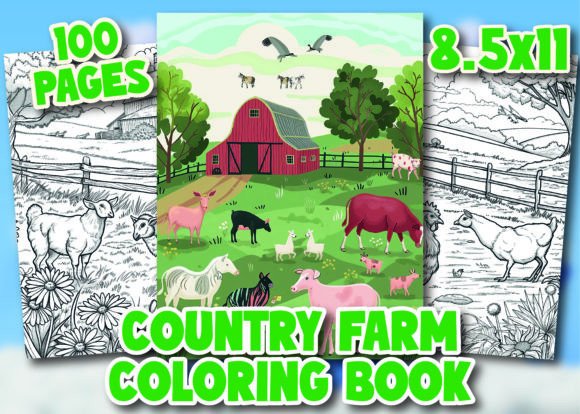
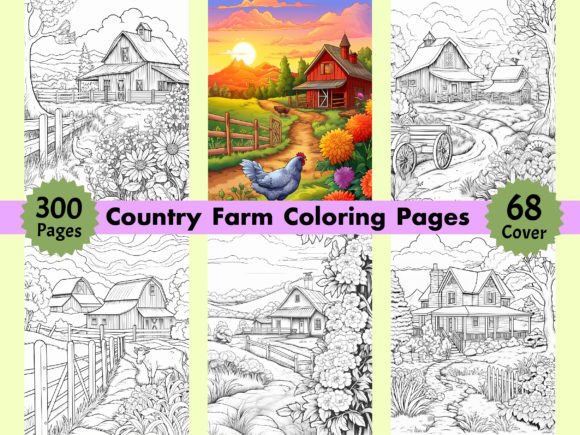
This particular volume—Vol. 03—is built with practical creators in mind. It includes 300 high-resolution JPG and PNG files, plus a print-ready PDF—all at 300 DPI and standard 8.5″ x 11″ size. That means crisp lines whether you’re printing at home, sending to a print-on-demand service like KDP, or scaling for a workshop handout. The four separate folders (JPG, PNG, PDF, and bonus book cover assets) aren’t just organizational—they signal intentionality. You won’t need to batch-convert files or guess which format suits your workflow.
And yes, these are AI-generated—but that doesn’t mean generic. The line work is clean, consistent, and intentionally varied: some pages emphasize texture (wood grain on fence posts, feather detail on chickens), others focus on open negative space for easy shading. That balance matters. Too much complexity overwhelms beginners; too little leaves experienced colorists unchallenged. This set lands in the middle—accessible without feeling diluted.
Mistake #1: Assuming “High DPI” Means “Print-Ready in Any Context”
300 DPI is excellent—but only if the file dimensions match your output needs. A 300 DPI image sized at 400×300 pixels won’t print clearly at 8.5″ x 11″. Here, it’s handled correctly: every JPG and PNG is native to that size at full resolution. Still, always verify before uploading to KDP. Open one file in Preview (Mac) or Photos (Windows), check image properties, and confirm it reads “8.5 x 11 inches @ 300 PPI.” Don’t rely solely on folder names or descriptions.
Mistake #2: Overlooking File Format Trade-Offs
JPGs are smaller and web-friendly but lack transparency. PNGs preserve clean edges and allow overlays—critical if you’re adding text, logos, or layered design elements later. The inclusion of both formats here is thoughtful. Use JPGs for fast previews or email drafts; reserve PNGs for final layouts, especially if you plan to add drop shadows, watermarks, or custom borders. And don’t skip the PDF—it’s pre-formatted for single-page printing, saving hours of manual layout in Canva or InDesign.
Mistake #3: Ignoring Licensing Clarity (Even With “Free” Assets)
The “Free 68 PNG Coloring Images For Book Cover” is generous—but “free” doesn’t automatically mean “commercially unrestricted.” Always recheck the license included with your download. These images are cleared for use in your own published works (including KDP titles), but they’re not for resale as standalone clipart or redistribution in asset packs. If you’re an educator sharing pages with students, or a marketer using them in client presentations, you’re covered. If you’re building a subscription-based design library? That’s outside scope. Read the terms—not just the headline.
Mistake #4: Treating AI-Generated Art as Interchangeable With Hand-Drawn
AI excels at consistency and scalability—but it can miss subtle human rhythm: slight line variation, intentional imperfection, or organic spacing. That’s fine for most adult coloring use cases (relaxation, skill-building, themed journals). But if your audience expects artisanal authenticity—say, for a premium craft zine or gallery collaboration—you’ll want to pair these pages with hand-lettered titles or custom textures. Think of this collection as a strong, reliable foundation—not a finished aesthetic. Layer thoughtfully.
What to Check Before You Download or Deploy
- Preview at actual size: Zoom to 100% on one JPG and one PNG. Look for jagged edges, unintended halos, or overly thin lines that might vanish when printed. These pages hold up well—but always spot-check.
- Test a KDP upload: Upload one PNG directly to Kindle Direct Publishing’s interior previewer. Does the grayscale rendering stay crisp? Do black lines remain solid (not washed out)? This set passes that test reliably.
- Confirm folder structure matches your workflow: If you use Adobe Bridge or Lightroom for asset management, the clean separation (JPG / PNG / PDF / Covers) saves tagging time. If you prefer flat directories, you can consolidate—but know that the organization exists to reduce friction, not create it.
- Scan for thematic balance: Flip through 20–30 random pages. Do animals, tools, structures, and landscapes appear with variety—not repetition? This volume avoids “tractor fatigue” by rotating focal points: a hayloft scene, then a chicken coop, then a field with wildflowers and distant silos.
Better Choices Start With Intentional Use
You don’t need 300 pages to begin—but having them means you can curate with confidence. A blogger writing about mindful rural living might pull 12 pages for a downloadable “Farmstead Calm” guide. A small business owner launching a farm-to-table café could use select images for menu inserts or loyalty cards. An educator might assign different scenes across seasons—planting in spring, harvest in fall—to reinforce science concepts visually.
The real value isn’t just quantity. It’s that each page is designed for function first: bold outlines, balanced composition, breathing room around subjects, and zero distracting background noise. No pixelated grass, no inconsistent lineweights, no surprise gradients where solid black should be. That reliability lets you focus on your goal—whether it’s calming anxiety, teaching observation skills, or launching a profitable KDP title—without troubleshooting assets.
If you’ve tried other country farm coloring sets and found them too sparse, too cluttered, or too technically finicky, this collection corrects those gaps quietly. It doesn’t shout “premium!”—it delivers it through consistency, clarity, and care in execution. And for adults who color not just to fill time, but to reconnect with simplicity, rhythm, and quiet intention? That’s exactly the kind of detail that matters.