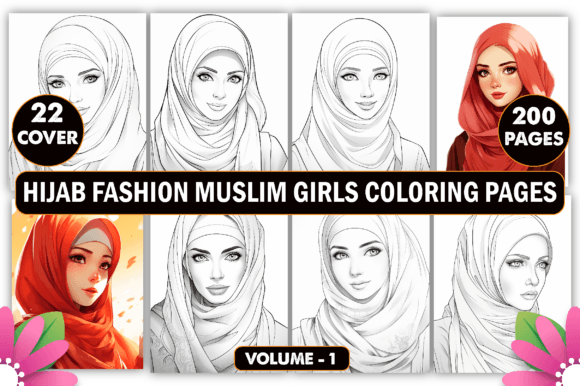
Hijab Fashion Muslim Girls Coloring Book
Coloring isn’t just for children—it’s a grounded, accessible practice that supports focus, emotional regulation, and cultural affirmation. For Muslim women, educators, content creators, and small business owners seeking meaningful, faith-aligned resources, the Hijab Fashion Muslim Girls Coloring Book stands out not as novelty merchandise, but as a thoughtfully designed tool rooted in real-life context and creative utility.
This isn’t a generic Islamic coloring book filled with repetitive silhouettes or symbolic motifs alone. It features 200 original black-and-white illustrations of Muslim girls and women wearing hijab in contemporary, everyday settings: browsing books in a library, selecting groceries at a supermarket, walking through a shopping mall, studying at a desk, or celebrating Eid with family. Each scene reflects modest fashion—abayas, jilbabs, layered tunics, coordinated hijab drapes—and avoids caricature or oversimplification. The result is representation that feels lived-in, respectful, and visually rich.
Why This Coloring Book Fits Real Creative and Professional Needs
For KDP publishers and digital product creators, the Hijab Fashion Muslim Girls Coloring Book delivers immediate production readiness: one print-ready PDF (A4 / 8.5×11″), plus 200 high-resolution JPG and PNG files—all at 300 dpi. There’s no need to trace, reformat, or adjust sizing. The interior pages are optimized for standard printing, and the 22-cover PNG options include front, back, and spine variations—ideal for launching a cohesive, culturally resonant product without outsourcing design.
Educators working in Islamic schools, weekend programs, or inclusive public classrooms find value here beyond art time. Pages set in libraries or classrooms can spark conversations about identity, choice, and belonging. A student coloring a girl reading quietly in a library may pause to reflect on knowledge as an act of worship—or how modesty and curiosity coexist. That quiet moment of engagement often opens doors to deeper dialogue, especially when paired with thoughtful facilitation.
A Resource That Scales Across Age and Intent
While marketed for “kids and adults,” its flexibility comes from intentional design—not broad labeling. Younger users (ages 7–12) connect with relatable scenes and clear line work. Teens and adults appreciate the stylistic detail: fabric folds, patterned hijabs, layered garments, and expressive postures that honor agency rather than passive portrayal. Unlike many coloring books that flatten cultural expression into decorative tropes, this one treats hijab fashion as dynamic, personal, and evolving—mirroring how Muslim women actually engage with dress today.
That realism matters for gift-giving too. As a Ramadan or Eid gift, it avoids tokenism. It’s not just “Islamic-themed”—it’s recognizably *of* the community: the girl holding a reusable grocery bag, the teen adjusting her hijab before a video call, the woman smiling beside a stack of books. Givers choose it because it affirms, not performs. Recipients keep it because it feels seen.
Practical Integration—Not Just Decoration
Freelancers and bloggers use individual pages as social media visuals—coloring-in progress shots, finished pages shared with reflections on modesty and creativity, or side-by-side comparisons showing how different color palettes shift mood and meaning. Because each file is delivered separately (200 PNGs/JPGs), repurposing is frictionless: no cropping, no quality loss, no licensing ambiguity.
Therapists and counselors working with Muslim youth sometimes incorporate coloring as a nonverbal grounding technique. Here, the familiarity of setting and dress lowers resistance. A child who hesitates to talk about school anxiety might relax while coloring a page set in a classroom—then begin sharing details about their own day. The imagery acts as a bridge, not a barrier.
What to Consider Before Using or Reselling
While the Hijab Fashion Muslim Girls Coloring Book excels in authenticity and production readiness, its strength lies in specificity—not universality. It centers urban, modern, middle-class contexts. Users seeking rural settings, diverse ethnic representations beyond South Asian and Arab visual cues, or disability-inclusive scenes (e.g., hijabi women using wheelchairs or hearing aids) will want to supplement or curate additional material. That doesn’t diminish its value—it clarifies its scope.
Also note: the files are print-optimized, not editable. If you need layered PSD files for customizing garments or swapping backgrounds, this isn’t the resource. But if your goal is fast, faithful, high-quality output—whether for resale, classroom use, or personal reflection—the package eliminates common bottlenecks: sourcing, formatting, and cultural vetting.
More Than a Coloring Book—A Quiet Act of Recognition
In a market where Islamic products often swing between austerity and ornamentation, this book holds steady in the middle: joyful but grounded, stylish but sincere, creative but purposeful. It doesn’t ask users to “learn about Islam” through abstraction—it invites them to inhabit moments where faith, fashion, and daily life intersect naturally.
That resonance explains why educators report extended engagement during coloring sessions, why small business owners cite repeat orders during Ramadan, and why adult users describe it as “the first coloring book I’ve kept on my desk instead of storing away.” Its usefulness isn’t loud or flashy. It’s in the clean lines, the consistent sizing, the absence of clutter—and the quiet confidence that modesty and self-expression aren’t opposites, but companions.
If you’re evaluating resources for teaching, creating, gifting, or publishing, ask: does it save time *without* sacrificing depth? Does it reflect people as they are—not as symbols? Does it work across platforms and purposes without requiring heavy adaptation? The Hijab Fashion Muslim Girls Coloring Book answers yes—to all three.
Grab your copy exclusively on Amazon.