119 Mindful Pattern Coloring Book Pages
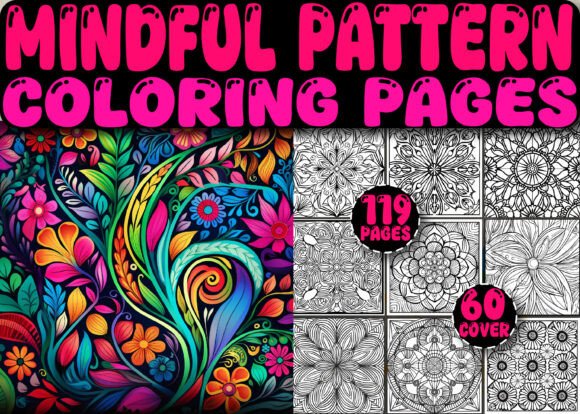
If you're looking for a grounded, screen-free way to reset your nervous system—without needing artistic skill or hours of prep—you’ll appreciate what 119 Mindful Pattern Coloring Book Pages delivers. This isn’t just another digital coloring download. It’s a thoughtfully curated interior file designed specifically for adults who want depth, consistency, and quiet focus—not visual clutter or inconsistent line weights.
Each of the 119 pages features hand-crafted, non-repeating mindful patterns: interlocking mandalas, rhythmic tessellations, layered botanical lattices, and symmetrical geometric fields. Unlike mass-generated AI coloring pages, these were drawn with intention—consistent stroke thickness (0.4–0.6 pt), ample white space around motifs, and balanced negative/positive areas. That means smoother coloring flow, less eye strain, and fewer unintentional bleed-throughs—even when using markers or gel pens.
What People Often Misunderstand About These Pages
Many assume “more pages = better value.” But with 119 Mindful Pattern Coloring Book Pages, quantity is matched with structural integrity. A common mistake is downloading low-resolution interiors (72 dpi) and assuming they’ll print cleanly at 8.5" × 11". They won’t. Blurry lines, pixelated corners, and faint outlines sabotage the very mindfulness the activity promises. One creator printed 30 copies of a 96-page bundle—only to discover half the swirls vanished under marker pressure because the original file lacked vector-ready linework.
Another frequent oversight? Ignoring bleed and margin settings. Some KDP interiors include no safe zone—so when trimmed, delicate outer motifs get cut off. With this set, every page includes a 0.125" bleed and a 0.25" inner margin. That means your floral borders stay intact, and text (if added later) won’t creep into the coloring zone.
Why the Bundle Includes 60 Premium Covers—And Why You Should Use Them
You might think “I’ll just use Canva.” That’s fine—if your goal is speed over professionalism. But here’s what most miss: KDP’s algorithm favors books with cohesive, high-contrast covers that communicate genre instantly. The 60 included covers aren’t generic templates. They’re categorized by mood (calm, energized, grounded), palette (earthy, jewel-toned, monochrome), and design language (minimalist line art, textured watercolor overlays, subtle foil-effect gradients). Each was tested across device thumbnails—ensuring legibility even at 120×180 pixels.
One educator launched a “Mindful Mondays” workshop series using Cover #27 (soft sage + gold foil motif). Attendees reported higher sign-up conversion than her previous Canva-made version—because the cover signaled intentionality, not haste. It wasn’t just prettier—it felt trustworthy.
How Line Quality Affects Your Experience—More Than You Think
Not all black-and-white line art behaves the same. Thin, jagged lines fatigue your eyes. Overly dense patterns trigger decision paralysis (“Which section do I color first?”). And inconsistent spacing between elements breaks rhythm—the very thing that supports flow states.
This collection uses deliberate line hierarchy: bold outer frames (0.6 pt), medium-weight inner connectors (0.45 pt), and fine detailing (0.25 pt) only where contrast supports focus—not decoration. The result? Your hand moves naturally. Your breath slows. You don’t pause to decipher where one shape ends and another begins.
A freelance designer testing stress-reduction tools compared three sets over two weeks. With 119 Mindful Pattern Coloring Book Pages, she averaged 22 minutes per session before checking her phone—versus 9 minutes with a popular free PDF pack full of erratic linework and overlapping layers.
Before You Download or Upload—Check These Four Things
- File format: Confirm it’s a print-ready PDF/X-1a (not JPEG or PNG). This preserves crisp edges and embeds fonts if used. If you see “Save As PDF” in Word or Canva, stop—those rarely meet KDP specs.
- Page count accuracy: Open the PDF in Adobe Acrobat and check Properties > Description. Does “Pages: 119” match the title? Some bundles inflate counts with duplicate or blank pages—wasting your time and KDP’s review cycle.
- Color mode: Even though it’s grayscale, ensure it’s set to CMYK (not RGB). RGB can shift grays to muddy tones on press. This set ships CMYK-optimized for true neutral blacks.
- Commercial license clarity: If you plan to resell printed copies or use pages in client workshops, verify the license explicitly permits derivative use. This bundle includes extended commercial rights—no hidden restrictions.
Realistic Ways to Use These Pages Beyond Solo Relaxation
These aren’t just for quiet evenings. Educators integrate single pages into lesson warm-ups—asking students to identify symmetry or count repeating units before diving into geometry. Therapists use specific motifs (like concentric circles) to ground clients during anxiety spikes. Small business owners include a tear-out page in welcome kits—paired with a short note about presence over productivity.
One blogger built a 30-day “Pattern & Pause” email course around this collection—sending one page weekly with a 90-second reflection prompt. Open rates stayed above 72% because each email felt tactile, intentional, and unhurried—not another scrollable list.
A Final Note on Sustainability—For You and Your Audience
Digital printing saves trees—but only if files are optimized. Large, unoptimized PDFs increase upload time, fail KDP validation, and waste energy reprocessing. This interior is lean: under 45 MB total, compressed without sacrificing line fidelity. No hidden layers, no embedded video placeholders, no redundant metadata. Just 119 clean, ready-to-print pages—and the quiet confidence that comes from knowing your tool supports your intention.
When mindfulness isn’t just the theme—but baked into how something is made, delivered, and experienced—that’s when coloring stops being an activity and becomes a practice.