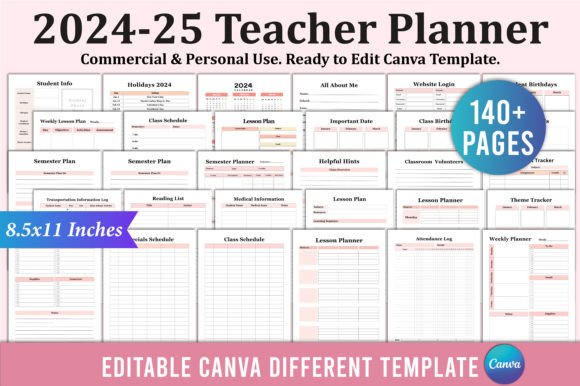
2024-25 Teacher Planner for Canva KDP
If you're a teacher, curriculum designer, or digital creator looking for a flexible, professional-grade planning tool that works *with* your workflow—not against it—the 2024–25 Teacher Planner for Canva KDP is more than just another printable. It’s a thoughtfully structured, editable Canva template designed to support real classroom needs while opening doors for creators building planner-based products.
What exactly is this planner—and why does the “Canva KDP” part matter?
This isn’t a static PDF you print and fill in with pen. It’s a fully editable Canva template—meaning every page, font, color, and layout element can be customized directly in Canva’s free or Pro interface. You don’t need design software like Illustrator or Photoshop. No coding. No steep learning curve. Just drag, type, adjust, and export.
The “KDP” designation signals its intentional compatibility with Amazon Kindle Direct Publishing’s interior requirements for physical planners. That means margins, bleed settings, and page dimensions are pre-optimized for print-on-demand—ideal if you’re creating your own branded planner to sell on Amazon or Etsy.
Why educators reach for this planner first
Teachers juggle dozens of responsibilities daily: lesson prep, attendance, parent communication, behavior tracking, medical logs, and long-term planning—all while staying compliant with district timelines and student privacy rules. The 2024–25 Teacher Planner for Canva KDP consolidates those scattered tasks into one consistent system.
Take the Student Birthday and Class Birthdays pages: they’re not just fun extras—they help build inclusive classroom culture and remind teachers to acknowledge milestones meaningfully. Or the Medications Tracker and Medical Information sections: these aren’t generic forms. They’re built with school nurse collaboration in mind—clear, HIPAA-conscious fields that reduce documentation errors.
For a 3rd-grade teacher starting her first year, the Daily Planner and Weekly Lesson Plan pages offer scaffolding—not rigidity. She can copy-paste her lesson objectives from district-provided templates, add visuals using Canva’s library, and tweak timing based on how her class actually moves through material.
How creators and small business owners use it differently
For independent designers and KDP publishers, this planner serves two roles: as a ready-to-sell product *and* as a customizable foundation. Because it’s built in Canva, you can quickly generate multiple versions—e.g., a “Montessori Edition” with observation log emphasis, or a “Special Ed Focus” version highlighting IEP goal tracking and behavior notes.
One freelance educator recently used the Semester Planner and Assignment Tracker pages to build a companion resource for her online course on differentiated instruction. She added her branding, swapped out icons, and embedded short video tips directly into the Canva slides—then exported as an interactive PDF for students.
That flexibility matters. Unlike locked PDFs or rigid Notion templates, this Canva-based structure supports both visual customization (fonts, colors, illustrations) and functional adaptation (reordering pages, deleting unused sections, adding custom tabs).
Beginners vs. experienced users: where priorities diverge
A new teacher might prioritize ease of use and clarity. She’ll appreciate that pages like All About Me, Student Info, and Class List come pre-labeled and logically grouped—no guessing where to start. She may never touch the Equations Formulas or Theme Tracker pages, and that’s okay. She can delete them before printing or simply skip over them.
An instructional coach or veteran department chair, however, will value consistency across teams and scalability. She might duplicate the Lesson Plan page 30 times, rename each tab by unit, then share the entire Canva file with her grade-level team—allowing everyone to edit their own version while maintaining shared formatting and terminology.
And for a solopreneur launching a teacher-focused newsletter? She might extract just the Helpful Hints and Smart Goals pages, rebrand them with her logo, and offer them as a free lead magnet—knowing they’re polished, classroom-tested, and instantly usable.
What about quality, reliability, and long-term usefulness?
This planner includes 2024 and 2025 calendar views, verified U.S. federal holidays, and monthly snapshots from January through December—so it stays accurate through the full academic year, including summer planning windows. Pages like Communications Log, Parent-Teacher Conference Notes, and Meeting Notes follow best practices for documentation: clean headers, ample space for narrative detail, and subtle cues (like date stamps and signature lines) that support accountability without clutter.
It’s also built with longevity in mind. The Reading List and Online Information pages don’t assume specific platforms—they leave room for whatever tools your school adopts next year. The Transportation Information Log and Seating Chart use neutral grids and labels so they work whether you teach in-person, hybrid, or via rotating cohorts.
Does it fit your goals?
Ask yourself:
- If you’re a teacher: Do you want one place to track lessons, behavior, health info, and parent contact—all editable without tech overhead? Yes → this fits.
- If you’re a creator: Are you building a planner to sell, but don’t want to design 50+ pages from scratch? Yes → this gives you production-ready structure and KDP-aligned formatting.
- If you’re a coach or PD facilitator: Do you need adaptable templates to model planning strategies with teachers? Yes → its modular design lets you highlight specific pages without overwhelming users.
- If you’re evaluating tools for your team: Is consistency, accessibility, and low-cost adoption important? Yes → Canva’s free tier supports full editing, and no licenses or subscriptions are required.
No single planner solves every problem—but the 2024–25 Teacher Planner for Canva KDP meets people where they are: whether you're mapping out your first week of kindergarten, preparing your first KDP upload, or redesigning your department’s planning process. It doesn’t replace judgment or pedagogy. It supports them—with clarity, care, and quiet efficiency.