Cute Kawaii Forest Jar Coloring Book V-1
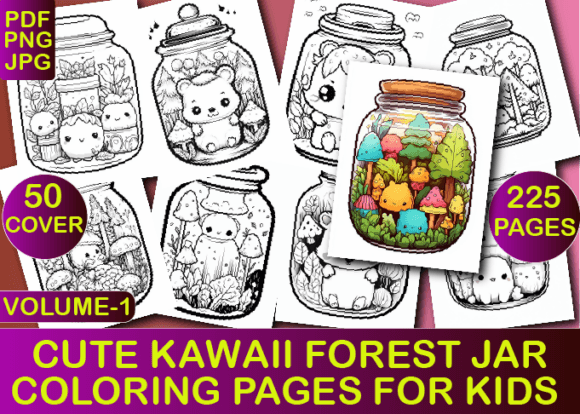
Imagine opening a jar—not to find jam or spices—but an entire enchanted forest, softly glowing with kawaii charm: tiny mushrooms with sleepy faces, foxes wearing leaf hats, owls holding teacups, and trees whose trunks curl like ribbons. That’s the heart of the Cute Kawaii Forest Jar Coloring Book V-1: a thoughtfully designed interior resource built for creators who value both whimsy and workflow.
This isn’t just another coloring book PDF. It’s a production-ready, high-resolution KDP interior toolkit—225 individual PNGs plus one polished 8.5” x 11” PDF with bleed—crafted to support real-world publishing goals. Every line is crisp, every outline intentional, and every illustration sized and spaced for optimal print clarity on standard US letter stock. The black-and-white format ensures compatibility across printers, platforms, and color systems—no guesswork, no revisions needed.
More Than Pages—A Creative Launchpad
For designers and self-publishers, the Cute Kawaii Forest Jar Coloring Book V-1 serves as a flexible foundation—not a finished product. You own full commercial rights to adapt, rebrand, and repurpose these assets. That means you can:
- Build your own branded coloring book series (e.g., “Forest Jar Seasons,” “Midnight Jar Edition,” or “Jar & Journal Combo Pack”)
- Integrate select illustrations into educational materials—like nature-themed classroom handouts or social-emotional learning activity sheets for elementary educators
- Use PNGs as layered elements in Canva or Adobe Illustrator to create themed digital planners, printable stickers, or even SVG cut files for crafters
- Develop companion content: pair pages with short mindfulness prompts, forest facts, or gentle writing exercises for adult relaxation audiences
The 50 included cover backgrounds aren’t decorative extras—they’re strategic starting points. Each is sized to match standard KDP cover dimensions and designed with subtle texture, soft gradients, or gentle framing to let your title and branding shine without competing with the art.
Real Applications, Real Audiences
Freelancers and small business owners often need fast-turnaround, high-perceived-value deliverables. This interior lets you offer premium coloring books without hiring illustrators or managing complex file prep. One client used 30+ illustrations from V-1 to launch a limited-edition “Forest Jar Calm Kit”—a bundle including the coloring book, a downloadable audio guide for mindful coloring, and a printable progress tracker. They priced it at $14.99 and marketed it through wellness-focused Instagram communities.
Educators have adapted the jar motif to teach thematic units: “What lives inside a forest jar?” becomes a cross-curricular prompt for science (habitats), art (pattern and symmetry), and language arts (descriptive writing). Because each illustration stands alone, pages can be printed individually—no need to bind full books for classroom use.
Bloggers and content creators use the PNGs to refresh their visual library. Instead of generic stock art, they drop in a kawaii fox holding a fern or a snail with a mushroom shell—adding warmth and recognizability to Pinterest pins, email headers, or blog sidebar graphics. Consistency builds familiarity; using the same style across platforms strengthens brand voice—even in non-commercial spaces.
Design Integrity Starts with Intentional Structure
The 225 illustrations follow a deliberate progression—not random cuteness. Early pages feature simpler outlines (ideal for younger kids or beginners), while later spreads introduce layered details: vines wrapping jars, constellations inside glass lids, or mirrored forest reflections. This natural scaffolding supports audience growth—whether you’re targeting ages 4–8, teens building fine motor skills, or adults seeking focused creative flow.
To keep your final book cohesive, consider grouping pages by theme rather than sequence: “Tiny Guardians” (animals), “Whispering Flora” (plants and fungi), “Jar Details” (textures, patterns, and borders). This approach helps readers navigate meaningfully—and gives you flexibility when designing your cover subtitle or Amazon description keywords (“kawaii forest animals,” “mindful coloring for kids,” “printable jar-themed activities”).
Workflow Tips for Best Results
If you're assembling your KDP book, start with the PDF interior—it’s pre-formatted with bleed and crop marks, so it prints cleanly right out of the gate. Use the PNGs only when you need to customize: swapping a background, adding text overlays, or creating alternate versions (e.g., “color-by-number” or “trace-and-color” variants).
When naming your final files, avoid generic labels like “page_01.pdf.” Instead, use descriptive, versioned names: forest-jar-kids-V1-interior-KDP-v2.pdf. This saves time during updates and keeps your project folder organized—especially if you plan to expand into V-2 or seasonal editions.
Test print at least three pages before ordering a full proof: one early, one mid-book, and one near the end. Check for line weight consistency, corner alignment, and bleed safety. The high-res source files minimize scaling issues, but physical paper absorbs ink differently than screens—so seeing it in hand matters.
Why This Works Beyond Trends
Kawaii aesthetics endure because they combine accessibility with emotional resonance—soft shapes, friendly expressions, and gentle scale invite engagement without pressure. The “forest jar” concept adds narrative depth: containment meets wonder, intimacy meets exploration. That duality makes it adaptable across niches—mental wellness, early education, gift retail, even boutique stationery.
But what truly sets the Cute Kawaii Forest Jar Coloring Book V-1 apart is its balance of charm and utility. It doesn’t ask you to chase virality or force personality where it doesn’t fit. It gives you clean, usable, copyright-safe assets—and trusts you to decide how, where, and why they matter to your audience.
You don’t need to be an illustrator to build something meaningful. You just need the right foundation, clear intent, and space to make it your own. That’s what this interior provides—not inspiration as decoration, but inspiration as infrastructure.